EN
EN
 fr
fr  de
de  es
es  it
it  ru
ru  pt
pt  ar
ar  th
th  pl
pl  ro
ro 
Choosing between a single hook and double hook configuration is less about which design is universally better and more about how the equipment fits the production workflow. For manufacturers processing castings, forgings, weldments, and other irregular metal components, the hook arrangement can influence loading organization, batch turnover, floor-space planning, and overall production continuity.
For companies evaluating a single hook vs double hook shot blasting machine, understanding these differences before requesting a quotation can make communication with the equipment manufacturer much more precise.
Quick Comparison: Single Hook and Double Hook Configurations
A single hook configuration generally uses one hanging position, while a double hook configuration uses two positions to support alternating loading and blasting workflows.
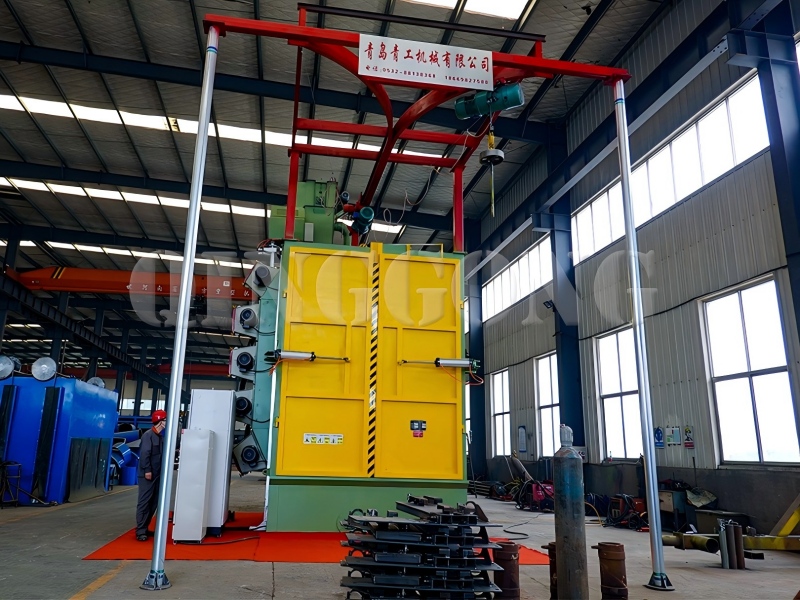
QINGGONG describes its hanger-type equipment as available in single-hook and double-hook configurations. Its double-hook design allows two hooks to alternate between the blasting chamber and loading or unloading activities, reducing the waiting associated with a single-position workflow.
| Factor | Single Hook | Double Hook |
|---|---|---|
| Basic configuration | One hook position | Two alternating hook positions |
| Workflow | Batch-oriented | Alternating batch workflow |
| Loading organization | Closely connected to blasting cycle | Can be organized separately from blasting |
| Production continuity | More dependent on batch turnover | Better suited to reducing waiting between batches |
| Layout | Simpler | Requires additional space planning |
| Typical consideration | Flexible, straightforward batch processing | Higher workflow continuity |
The important point is that hook quantity alone does not determine production performance. Workpiece characteristics, batch organization, labor flow, and available space must be evaluated together.
Cycle-Time Difference and Loading During Blasting
The main production difference between single-hook and double-hook systems is how loading and blasting activities are organized within the production cycle.
With a single-hook arrangement, the same hanging position is involved in the complete batch sequence. This creates a straightforward workflow, but loading and unloading are more closely tied to the blasting cycle.
A double-hook arrangement can separate these activities more effectively. While one hook is associated with the blasting process, the other can be prepared for the next batch, depending on the machine design and production layout. QINGGONG's published description specifically identifies this alternating arrangement as a way to reduce loading-waiting time.
For production planning, the relevant question is therefore not simply how long one blasting cycle lasts. It is how much of the overall production cycle is occupied by loading, blasting, unloading, and batch changeover.
Part Weight, Envelope, and Rotation Requirements
Workpiece dimensions, weight, geometry, and required exposure are fundamental factors when evaluating a hanger-type shot blasting machine.
QINGGONG's published hanger-type range includes models with maximum batch diameters from 700 mm to 3,000 mm, maximum workpiece heights from 1,200 mm to 3,000 mm, and listed maximum workpiece weights ranging from 600 kg to 10,000 kg depending on model.
These figures should be treated as published equipment ranges rather than universal recommendations. Actual suitability depends on the customer's workpiece dimensions, loading arrangement, required coverage, and machine configuration.
Irregular castings and welded structures can also require careful consideration of how the workpiece is suspended and exposed inside the blasting chamber. This is one reason hanger-type equipment is commonly used for medium and large irregular components.
When Double-Station Flow Improves Output
A double-station workflow can improve production continuity when loading and unloading would otherwise create significant waiting between blasting batches.
The benefit becomes more meaningful when the production process contains frequent batch changes. Instead of treating the machine as a single isolated processing station, the double-hook concept allows the upstream and downstream material flow to be considered alongside the blasting cycle.
For example, a production line processing multiple batches of similar components may benefit from separating the preparation of the next batch from the active blasting position. The actual productivity improvement, however, depends on the complete production arrangement rather than on hook quantity alone.
This distinction is important for B2B buyers: a double hook should not automatically be presented as a “higher-output” solution without considering the actual production bottleneck.
Floor Space, Maintenance Access, and Labor
Floor-space planning for hanger equipment should account for the machine body, hook movement, loading areas, maintenance access, dust-control equipment, and material flow.
QINGGONG's hanger-type machines are offered in different configurations, including pit-free designs on several published models. The manufacturer's specifications also show that larger models may require a foundation pit, demonstrating that installation requirements can vary considerably by machine size.
Space planning should therefore be considered before the final equipment configuration is established.
Dust collection is another important part of the overall system. OSHA's abrasive-blasting standard addresses ventilation and dust hazards, while NIOSH emphasizes engineering controls such as ventilation and machine safeguards as important approaches to workplace hazard reduction.
For a professional project, maintenance access, material movement, enclosure design, ventilation, and applicable workplace requirements should be reviewed by qualified personnel.
Example Capacity Calculation for a Batch
A useful production calculation should consider the complete batch cycle rather than looking only at the nominal blasting time.
For example, if a production department evaluates a hypothetical batch workflow, the planning model can be expressed conceptually as:
Total cycle time = loading + preparation + blasting + unloading + changeover
The purpose of this calculation is to identify where production time is actually being consumed.
If loading and unloading occupy a significant portion of the total cycle, a double-hook configuration may deserve further engineering evaluation. If batch turnover is already well organized and the primary requirement is flexible processing, a single-hook concept may provide a simpler production arrangement.
Actual machine capacity should always be confirmed by the manufacturer against the customer's workpiece dimensions, batch weight, required surface result, and production conditions.
Which Configuration Should Be Quoted?
The appropriate configuration should be determined from the customer's workpieces and production workflow rather than from hook quantity alone.
For an initial quotation, useful project information includes workpiece dimensions, maximum batch weight, typical batch quantity, material type, surface condition, expected production volume, available floor space, and the required surface result.
QINGGONG states that its hanger-type machines can be customized according to workpiece dimensions and production requirements, with different hook arrangements and machine configurations available.
For broader equipment comparison, the hanger type shot blasting machine range provides the starting point for evaluating hook-based systems. The dedicated double hook shot blasting machine page provides additional model information for the two-hook configuration.
Companies comparing different blasting technologies can also review ShotblastPro's shot blasting machine range to determine whether a hanger system fits their overall application.
Why Safety and Dust Control Belong in the Specification
A production-based comparison should include dust containment, ventilation, guarding, and applicable workplace requirements as part of the equipment system.
OSHA's 29 CFR 1910.94 specifically addresses abrasive blasting, including blast-cleaning enclosures, ventilation, and dust hazards. NIOSH likewise identifies engineering controls as a preferred approach for reducing workplace exposure to hazards.
This makes safety-related system design an important part of professional equipment evaluation rather than an afterthought.
Conclusion
The difference between a single hook and double hook shot blasting machine is fundamentally a production-flow question.
A single-hook system offers a straightforward batch-oriented arrangement, while a double-hook configuration can support a more continuous loading and blasting workflow by alternating hanging positions. The best choice depends on workpiece dimensions, batch characteristics, production rhythm, available space, labor organization, and the complete equipment system.
For QINGGONG, equipment selection starts with the customer's actual workpieces and production requirements. Providing accurate information about dimensions, weight, batch quantity, surface requirements, and production expectations gives the engineering team a stronger basis for developing an appropriate hanger-type solution.
For project-specific discussion, buyers can contact QINGGONG Machinery with their workpiece information and production requirements.
FAQ
1.What is the main difference between single hook and double hook shot blasting machines?
The primary difference is the number of alternating hanging positions and how loading, blasting, and unloading are organized within the production cycle.
2.Is a double hook shot blasting machine always more productive?
Not necessarily. Its potential advantage comes from workflow organization and reduced waiting between batches. Actual productivity depends on the complete production process.
3.What workpieces are suitable for hanger-type shot blasting machines?
Hanger systems are commonly used for medium and large castings, forgings, weldments, and irregular or slender components that require controlled hanging and exposure.
4.How much can a hanger-type shot blasting machine handle?
Published QINGGONG models cover a broad range, with listed maximum batch diameters from 700 mm to 3,000 mm and maximum listed weights reaching 10,000 kg on the largest standard model. Actual suitability depends on the specific machine and application.
5.What information should be included in a quotation request?
Workpiece dimensions, maximum weight, batch quantity, material, surface condition, production expectations, available space, and required finishing or cleaning result provide useful information for engineering evaluation.
6.Why should dust collection be considered when comparing machines?
Abrasive blasting can generate respirable dust, so ventilation, enclosure, dust collection, and other applicable engineering controls should be considered as part of the complete system. OSHA specifically addresses these issues in its abrasive-blasting requirements.
External references:
OSHA — Abrasive Blasting & Ventilation Requirements