EN
EN
 fr
fr  de
de  es
es  it
it  ru
ru  pt
pt  ar
ar  th
th  pl
pl  ro
ro 
Compare blast rooms, blast booths, and blasting chambers by workpiece size, operator access, abrasive recovery, ventilation, and production requirements.
When buyers start looking for a blast room for sale, they often encounter three terms: blast room, blast booth, and blasting chamber. The problem is that suppliers do not always use these terms in exactly the same way.
For a purchasing team, the name of the equipment matters less than how it will be used. A large fabricated structure, a steel frame, and a batch of smaller components can all require very different blasting arrangements.
The better starting point is therefore the workpiece, production volume, handling method, and available workshop space.
The Practical Difference Between a Blast Room, Booth, and Chamber
A blast room is generally a walk-in enclosure designed around large or irregular workpieces, while a blast booth or chamber can refer to a more compact or application-specific enclosed blasting area.
OSHA uses the term “blast cleaning room” for a complete enclosure in which the operator works inside and directs the abrasive blasting nozzle.
In commercial equipment terminology, however, the boundaries are not always so clear. Some manufacturers call a large enclosed system a blasting chamber; others use blast booth for a similar configuration.
That is why buyers should look beyond the product name. Ask how the equipment handles the workpiece, where the operator stands, how abrasive is recovered, and how dust is collected.
For a container-based project, an enclosed container blasting chamber can be a practical option when the customer needs a modular enclosure rather than a permanently constructed room. Qinggong's Container Blast Room is designed around this type of application.
.jpg "Container Blast Room")
Part Size and Operator Access Usually Make the Decision
The size and shape of the workpiece often determine the enclosure more clearly than the blasting method itself.
A large steel structure may need enough internal space for an operator to move around the component and reach different surfaces. A smaller component that follows a repeatable production route may benefit from a more compact booth and a more controlled handling system.
Loading is another point that is easy to overlook. A room may have enough internal space but still be inconvenient if the workpiece cannot be moved in and out efficiently.
For container-based solutions, Qinggong lists 20-ft and 40-ft transportable configurations, providing a useful reference when customers are assessing available space and the size of components they expect to process.
The important figures for an RFQ are therefore the maximum length, width, height and weight of the workpiece, rather than simply saying that a “large blast room” is required.
Air-Blast or Wheel-Blast?
The enclosure and the blasting system should be considered together.
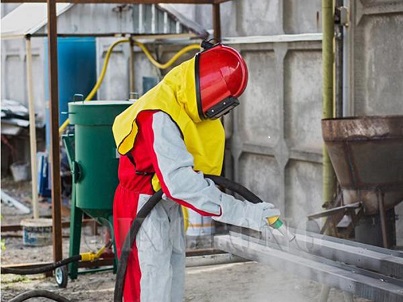
Air-blast equipment is often chosen when the operator needs to control the blasting direction manually and deal with varying component shapes. Wheel-blast systems are more closely associated with repeatable production where parts can be positioned consistently.
This distinction becomes important when a buyer is comparing a manual sand blasting booth with a larger production system. A larger room does not automatically mean higher productivity. If the parts are small and repetitive, the additional floor space may provide little benefit.
Conversely, using a compact enclosure for oversized or irregular components can make loading, operator movement, and surface coverage unnecessarily difficult.
For steel preparation projects, ISO 8501-1 is commonly referenced for visual assessment of rust and preparation grades, including surfaces prepared by blast-cleaning. The current published edition is ISO 8501-1:2007.
Ventilation and Abrasive Recovery Should Be Part of the Specification
Ventilation is one of the most important differences between a properly engineered blasting system and a simple enclosed workspace.
OSHA requires blast-cleaning enclosures to be exhaust ventilated so that air flows inward through openings during blasting. The standard also addresses dust collection and abrasive separation where media is recirculated.
Abrasive recovery has a direct effect on how the room operates over time. A system designed for occasional manual work may use a different recovery arrangement from one intended for regular industrial production.
This is particularly relevant when comparing sandblasting booths for larger equipment. The enclosure, floor recovery, separator, dust collector and blasting equipment need to work as one system.
For customers who need a relocatable solution, Qinggong's Transportable Container Blast Room is worth considering as an alternative to constructing a fixed room.
Blast Room vs Blast Booth vs Blasting Chamber
The following comparison is more useful for purchasing discussions than simply comparing the terminology:
| Consideration | Blast Room | Blast Booth | Blasting Chamber |
|---|---|---|---|
| Typical workpiece | Large or irregular parts | Small to medium parts | Depends on configuration |
| Operator access | Usually walk-in | More controlled | Application dependent |
| Layout flexibility | High | Moderate to high | High when customized |
| Abrasive recovery | Often integrated | Depends on system | Depends on design |
| Production focus | Large-part preparation | General or repetitive work | Customized applications |
| Installation | Fixed or modular | Fixed or modular | Fixed or modular |
There is no single configuration that is best for every project. A fabricator handling large steel structures may have completely different requirements from a manufacturer processing smaller components every day.
What Should Be Included in an RFQ?
A useful RFQ does not need to be complicated. The supplier mainly needs enough information to understand the work and the environment in which the equipment will be installed.
Start with the largest and smallest workpiece dimensions, maximum weight, material, existing surface condition, required preparation grade, abrasive type, expected production volume, loading method, available workshop space, and whether the system needs to be movable.
It is also worth providing photographs or drawings of representative workpieces. A simple workshop layout can help the supplier understand access and installation constraints much faster than a long written description.
For steel surface preparation, referring to the required ISO preparation grade is preferable to using vague terms such as “clean steel.” ISO 8501-1 defines standardized rust and preparation grades for steel substrates.
Which Qinggong System Makes Sense?
For buyers looking at a portable container blast room, mobility and installation conditions will usually be among the first questions to settle. Qinggong's transportable container solution is intended for projects where the blasting room needs to be delivered as a modular system.
For a more conventional industrial installation, an Industrial Sandblasting Room can be considered where the layout, recovery system and ventilation arrangement need to be developed around the customer's production process.
The key point is that Qinggong does not need the buyer to decide everything from the terminology alone. Workpiece dimensions, production requirements and site conditions provide a much better basis for selecting the room configuration.
Conclusion
Choosing between a blast room, blast booth and blasting chamber is ultimately a question of how the equipment will fit the production process.
If the work involves large or irregular components and operators need to work inside the enclosure, a blast room is often the more practical direction. Smaller or more repetitive work may be better suited to a booth-style arrangement. A container-based chamber becomes particularly interesting when modular installation or transportation is part of the project.
For a quotation from Qinggong, providing the workpiece dimensions, maximum weight, abrasive information, required surface condition, expected production volume and workshop layout will make the discussion much more productive.
FAQ
1. What is the main difference between a blast room and a blast booth?
A blast room is generally designed as a walk-in enclosure for larger workpieces, while a blast booth is often used for smaller or more controlled blasting applications.
2. Is a blasting chamber different from a blast room?
Not necessarily. The terminology varies between suppliers. The enclosure design, workpiece capacity and blasting method are more important than the name.
3. When is a container blast room a good option?
It can make sense when the project requires a modular enclosure, has limited construction requirements, or may require the blasting facility to be relocated.
4. What information should I provide when requesting a quotation?
Provide workpiece dimensions and weight, material, surface condition, abrasive type, production volume, loading method and available installation space.
5. Why does abrasive recovery matter?
It affects media consumption, housekeeping and the overall design of the blasting system. Recovery requirements should be considered together with the dust-collection and ventilation system.
6. Which Qinggong blasting room should I choose?
The answer depends on the workpiece, production requirements and site conditions. Qinggong can recommend a suitable configuration after reviewing the application and layout.