EN
EN
 fr
fr  de
de  es
es  it
it  ru
ru  pt
pt  ar
ar  th
th  pl
pl  ro
ro 
A portable container blast room can solve a practical problem for manufacturers and contractors: how to create a dedicated blasting area without building a large permanent room. But the container itself is only one part of the project. Before requesting a quotation, buyers need to know whether the available space, workpiece dimensions, lifting route, utilities and production requirements are compatible with the proposed system.
For QINGGONG, these site conditions are also the starting point for equipment configuration. The company's transportable systems are available in 20-ft and 40-ft formats, providing a useful reference for projects where mobility and installation flexibility are important.
When a Portable Container Blast Room Makes Sense
A portable container blast room is most suitable for projects where a dedicated blasting enclosure is needed but a permanent building structure is not the preferred solution.
This can apply to steel fabrication, equipment refurbishment, maintenance contractors, rental operations and temporary production sites. A container-based layout can also be attractive when workshop space is limited or the blasting area may need to move later.
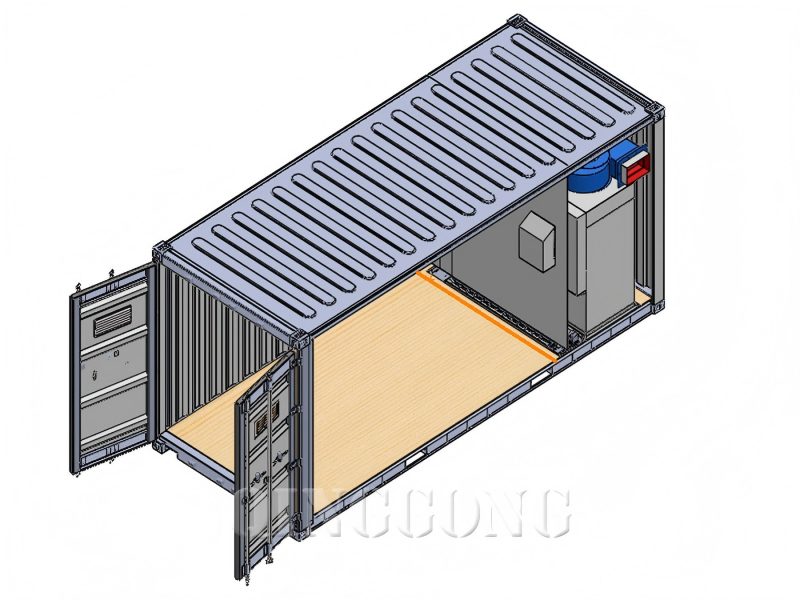
QINGGONG's published transportable configuration is designed to be placed on the ground without a conventional foundation pit. The system integrates the blasting area, dust collection and abrasive-handling components into a transportable package.
For a long-term fixed installation, buyers may have different requirements. In that case, QINGGONG's industrial sandblasting room range provides a larger platform for customized room dimensions, material handling and recovery arrangements.
Start With the Largest Workpiece, Not the Container
The required room size should be established from the largest workpiece and its complete loading path rather than from the nominal container length alone.
A workpiece may fit inside a room on paper but still create a difficult layout if the door opening, crane path or loading area is inadequate. Weight matters as well, particularly when large fabricated components need overhead handling.
QINGGONG currently lists two transportable configurations:
| Configuration | Published Dimensions | Published Dust Collector |
|---|---|---|
| QGC20FT | 6,000 × 2,300 × 2,300 mm | 3 kW |
| QGC40FT | 12,000 × 2,300 × 2,300 mm | 5.5 kW |
These are QINGGONG's published standard configurations, not universal design limits. A project involving oversized components should be reviewed against the actual workpiece dimensions, handling method and production requirements.
This is also where a portable sandblasting booth can differ from a conventional workshop enclosure: transportability becomes part of the equipment specification.
Utilities Should Be Confirmed Before Equipment Layout
A site plan should account for electrical supply, compressed air, equipment location and grounding requirements before the final system is approved.
The available utilities can affect the configuration of the dust collector and blasting equipment. They can also determine where the system can realistically be installed within an existing workshop.
Ventilation deserves particular attention because abrasive blasting produces dust that must be controlled within the enclosure and exhaust system. OSHA's abrasive-blasting requirements in 29 CFR 1910.94 cover enclosure ventilation, exhaust systems and related requirements. OSHA 29 CFR 1910.94 – Ventilation
NIOSH also identifies engineering controls, including ventilation and physical barriers, as important approaches for controlling workplace exposure. NIOSH Engineering Controls
Dust Collection and Abrasive Recovery Need to Match Production
Dust collection and abrasive recovery should be selected together because both influence the cleanliness, maintenance requirements and overall efficiency of the blasting area.
A smaller portable system may suit intermittent work, while a higher-output operation may justify a more extensive recovery arrangement. Abrasive type is another important variable because different media have different handling and reuse characteristics.
QINGGONG's transportable container systems use cartridge-type dust collectors. Its broader blast room range can also incorporate floor recovery and other abrasive-handling configurations according to project requirements.
For buyers comparing shipping container blast rooms with conventional rooms, the important question is therefore not simply which enclosure costs less. The recovery method, dust collection capacity, workpiece handling and expected production volume should all be considered together.
Plan the Site Around Transport and Material Handling
The installation location should be checked before the equipment is ordered, especially when the system will arrive as a complete containerized unit.
Access roads, workshop doors, overhead clearance, crane access and the final positioning area can all affect installation. If the room may be relocated in the future, the transport route should also be considered at the planning stage.
QINGGONG's transportable container blast room is offered in 20-ft and 40-ft configurations and is intended for projects where the blasting facility may need to be moved between locations.
For a permanent workshop, a fixed container blasting room may be a better fit when mobility is less important than long-term production layout.
What Information Should Be Included in an RFQ?
A useful RFQ should describe the production environment, not just ask for the price of a blast room.
| Project Information | Why It Matters |
|---|---|
| Maximum workpiece size | Determines usable room envelope |
| Maximum workpiece weight | Influences handling and loading design |
| Daily production | Helps evaluate system capacity |
| Abrasive type | Affects recovery and dust collection |
| Loading method | Determines door and access requirements |
| Workshop dimensions | Confirms available footprint |
| Electrical supply | Helps match equipment configuration |
| Compressed-air information | Supports system evaluation |
| Indoor or outdoor installation | Affects site planning |
| Future relocation | Determines mobility requirements |
For steel surface preparation projects, the required surface condition should also be clearly specified. ISO 8501-1:2007 provides internationally recognized preparation grades for steel substrates. ISO 8501-1:2007
Providing this information at the quotation stage allows QINGGONG engineers to evaluate the project based on actual conditions instead of assuming a standard application.
Portable Container Blast Room vs. Fixed Blast Room
The choice between a portable and fixed arrangement mainly comes down to mobility, available space and the expected production environment.
| Factor | Portable Container Room | Fixed Blast Room |
|---|---|---|
| Mobility | High | Low |
| Installation footprint | More standardized | Highly customizable |
| Site construction | Relatively simple | More extensive |
| Large workpieces | Depends on container size | Easier to customize |
| Recovery options | Configuration-dependent | Wider customization |
| Temporary projects | Well suited | Less suitable |
| Long-term expansion | More limited | More flexible |
A portable system is not automatically the better choice simply because it is easier to install. If production is expected to expand or the workpieces vary substantially in size, a customized fixed room may provide greater long-term flexibility.
How QINGGONG Can Help With Site Planning
QINGGONG MACHINERY approaches a container blast room as part of the customer's production layout rather than as an isolated enclosure.
For an initial review, provide the largest workpiece dimensions and weight, expected daily output, abrasive type, available workshop space and a simple floor plan. Photos of the installation area can also help clarify access and handling conditions.
Based on these details, the equipment configuration can be evaluated before the project moves to detailed quotation and layout development.
Conclusion
Choosing a portable container blast room is ultimately a site-planning decision. The right configuration needs to accommodate the largest workpiece, material-handling route, available utilities, dust collection, abrasive recovery and future mobility requirements.
QINGGONG's 20-ft and 40-ft transportable configurations give buyers a practical starting point, while customized solutions can be considered when standard dimensions do not match the application.
For a project-specific recommendation, send QINGGONG your workpiece dimensions, daily output, abrasive type and workshop floor plan for a preliminary layout review.
FAQ
1. What is a portable container blast room?
It is a containerized blasting enclosure designed to provide a dedicated blasting area while allowing greater mobility than a conventional permanent room.
2. What sizes are available from QINGGONG?
QINGGONG publishes 20-ft and 40-ft transportable configurations measuring 6,000 × 2,300 × 2,300 mm and 12,000 × 2,300 × 2,300 mm respectively.
3. How do I determine the required blast room size?
Start with the largest workpiece, its weight and loading route. Then consider available workshop space, operator access and material-handling equipment.
4. What utilities are required?
Electrical power and compressed air are key project inputs. The exact requirements depend on the selected blasting and dust-collection configuration.
5. Can a container blast room be moved to another site?
Transportability is one of the main advantages of QINGGONG's containerized systems, although relocation should be evaluated against the specific installation and transport conditions.
6. What should I provide when requesting a quotation?
Provide maximum workpiece dimensions and weight, expected production volume, abrasive type, workshop dimensions, loading method, available utilities and, ideally, a workshop floor plan.