EN
EN
 fr
fr  de
de  es
es  it
it  ru
ru  pt
pt  ar
ar  th
th  pl
pl  ro
ro 
A shot blasting machine is industrial equipment used to clean, strengthen, or prepare the surface of metal components by propelling abrasive media—typically steel shot or steel grit—at high speed onto a workpiece. The process removes rust, mill scale, welding slag, old coatings, and other contaminants while creating a uniform surface profile that improves paint adhesion, coating performance, and fatigue resistance.
Unlike abrasive blasting systems that rely on compressed air, most industrial automatic shot blasting machines use high-speed centrifugal blast wheels to accelerate the abrasive. This mechanical method provides greater efficiency, lower operating costs, and consistent cleaning quality, making shot blasting one of the most common surface preparation technologies in manufacturing.
Today, industries including automotive, foundry, steel fabrication, shipbuilding, rail transportation, wind energy, and heavy equipment manufacturing rely on automatic shot blasting systems to improve productivity and ensure consistent product quality. Manufacturers such as QGMA provide specialized equipment for different workpieces and production requirements.
Definition and Working Principle
The purpose of a shot blasting machine is to clean or modify a surface through the controlled impact of abrasive particles.
A typical blasting cycle consists of four steps:
1. Steel shot or grit is fed into a blast wheel.
2. The blast wheel accelerates the abrasive to high velocity.
3. The abrasive strikes the workpiece surface, removing contaminants and creating the desired surface roughness.
4. The abrasive is collected, separated from dust and debris, and recycled for continuous use.
This closed-loop recycling system allows a shot blasting clean machine to operate efficiently with minimal abrasive waste.
Surface cleanliness after blasting is commonly evaluated according to ISO 8501-1, which defines internationally recognized preparation grades for steel surfaces before coating.
Main Components of a Shot Blasting Machine
Although designs vary depending on the application, most machines contain several essential systems.
Blast Wheel
The blast wheel is the core component of an automatic shot blaster. Rotating at high speed, it accelerates abrasive media toward the workpiece with consistent velocity and coverage.
Abrasive Recovery System
Steel shot is continuously recovered through screw conveyors, bucket elevators, and air separators. This system removes broken abrasive and contaminants before recycling reusable media back into the blast wheel.
Proper abrasive recycling significantly reduces operating costs and material consumption compared with disposable blasting methods.
Dust Collection System
Industrial dust collectors remove fine particles generated during blasting, improving workplace safety and helping manufacturers meet environmental requirements.
Material Handling System
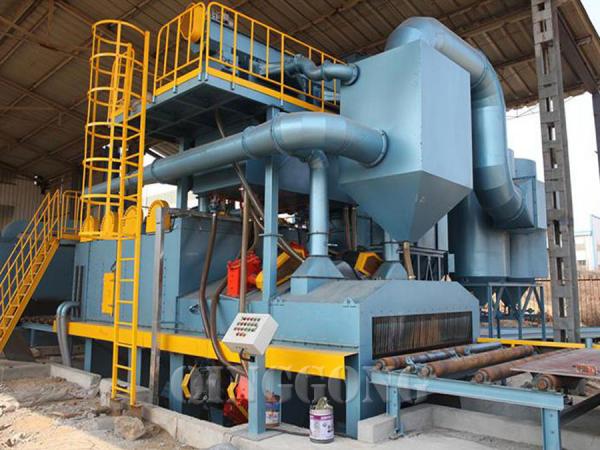
Different machine types use different conveying methods, including roller conveyors, overhead hooks, rubber crawlers, rotary tables, or wire mesh belts, depending on the size and geometry of the workpieces.
Types of Shot Blasting Machines
Different manufacturing processes require different blasting equipment.
Machine Type | Typical Applications |
Roller Conveyor Machine | Steel plates, H-beams, structural steel |
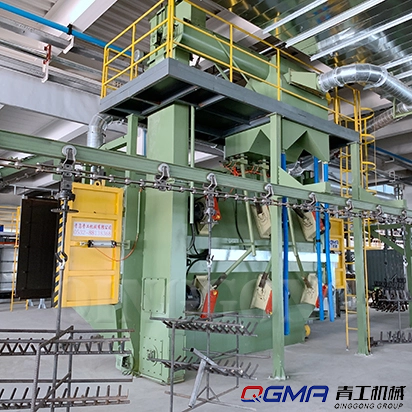
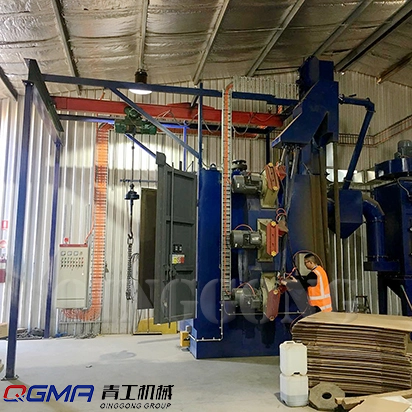
Hook Type Machine | Weldments, castings, fabricated parts |
Rotary Table Machine | Heavy circular components |
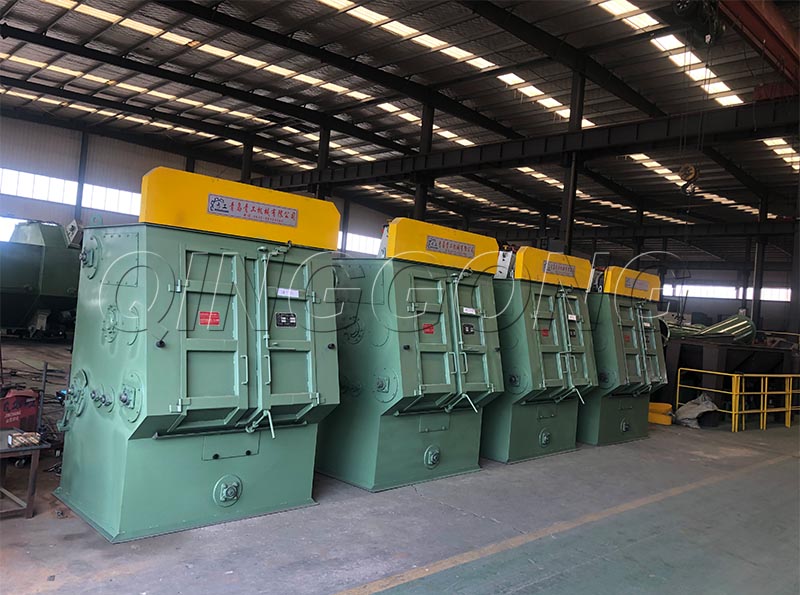
Tumble Belt Machine | Small castings and forgings |
Wire Mesh Belt Machine | Aluminum and thin metal parts |
Pipe Shot Blasting Machine | Steel pipes and tubes |
Overhead rail shot blasting machine | Castings, welded parts and other workpieces, ideal for factories with high production efficiency requirements. |
Automatic Shot Blasting Machine vs. Manual Blasting
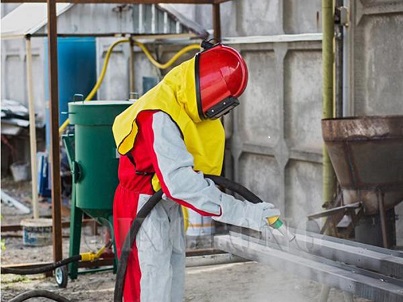
Automation has transformed industrial surface treatment by improving consistency and reducing labor requirements.
Feature | Manual Blasting | Automatic Shot Blast Machine |
Productivity | Low | High |
Labor Requirement | High | Low |
Surface Consistency | Depends on operator | Uniform |
Abrasive Recycling | Limited | Automatic |
Dust Control | Moderate | Excellent |
Long-Term Cost | Higher | Lower |
Modern automatic shotblasting systems can operate continuously with programmable controls, making them ideal for high-volume manufacturing.
Common Industrial Applications
Shot blasting is used across numerous industries wherever clean, properly prepared metal surfaces are required.
Automotive Manufacturing
Automotive manufacturers use automatic shot blasting machines to clean engine blocks, transmission housings, suspension parts, brake components, and electric motor housings before machining or coating.
Specialized motor shell shot blasting machines are commonly used for electric vehicle motor production.
Steel Fabrication
Structural steel, beams, bridges, storage tanks, and fabricated weldments are blasted before painting to improve coating adhesion and corrosion resistance.
Foundries
Castings often leave the mold with residual sand, flash, oxide scale, and burrs. Shot blasting efficiently removes these defects before machining or inspection.
Power Equipment
A transformer shot blasting machine prepares transformer tanks and fabricated electrical enclosures for protective coatings that improve long-term corrosion resistance.
Bearing Manufacturing
A ball bearings shot blasting machine cleans bearing rings while maintaining dimensional accuracy. Controlled shot peening can also improve fatigue strength by introducing beneficial compressive stresses into the material surface.
Advantages of Shot Blasting
Shot blasting offers numerous advantages compared with manual cleaning methods.
High Cleaning Efficiency
Mechanical blast wheels propel abrasive media much faster than compressed-air systems, making them ideal for continuous production.
Excellent Surface Preparation
Shot blasting creates a uniform anchor profile that improves paint adhesion and coating durability. Surface preparation quality directly influences coating service life.
Lower Operating Costs
Improved Mechanical Properties
In addition to cleaning, shot blasting and shot peening can increase fatigue resistance and extend component service life by reducing tensile surface stresses.
Environmentally Friendly Operation
Modern dust collection systems minimize airborne particles and recover reusable abrasives, reducing waste generation and improving workplace conditions.
How to Choose the Right Shot Blasting Machine
Selecting the appropriate machine depends on several technical factors.
Selection Factor | Considerations |
Workpiece Size | Small parts or large structures |
Material Type | Carbon steel, stainless steel, aluminum |
Production Volume | Batch or continuous production |
Surface Finish | Cleaning, descaling, peening, coating preparation |
Automation Level | Manual, semi-automatic, fully automatic |
Abrasive Type | Steel shot, steel grit, stainless shot |
Companies searching for shot blasting machine wholesale solutions should also evaluate equipment reliability, maintenance requirements, spare parts availability, and technical support.
Manufacturers such as QGMA -ShotBlastPro offer complete product lines ranging from compact batch systems to fully automated production-line solutions for steel fabrication, foundries, and heavy industries.
Shot Blasting vs. Sandblasting
Although the terms are often used interchangeably, they are different technologies.
Feature | Shot Blasting | Sandblasting |
Propulsion Method | Centrifugal blast wheel | Compressed air |
Common Abrasive | Steel shot or grit | Sand or other media |
Production Scale | High-volume manufacturing | Small or portable applications |
Abrasive Recycling | Excellent | Limited |
Operating Cost | Lower in mass production | Higher for large-scale work |
Industrial manufacturers increasingly choose automatic shot blasting because it delivers faster cleaning, better consistency, and lower operating costs.
Future Development Trends
As Industry 4.0 technologies become more common, modern shot blasting equipment continues to evolve.
Recent innovations include:
PLC-based intelligent control
Touchscreen operation
Automatic abrasive flow adjustment
Predictive maintenance systems
Remote equipment monitoring
Energy-efficient blast wheels
Robotic loading and unloading
Real-time production data collection
These technologies improve productivity while reducing downtime and maintenance costs.
Conclusion
A shot blasting machine is an essential piece of industrial equipment used to clean, strengthen, and prepare metal surfaces for subsequent manufacturing processes. Whether used in automotive production, foundries, structural steel fabrication, or power equipment manufacturing, modern automatic shot blasting machines provide efficient cleaning, consistent surface quality, and lower long-term operating costs.
By selecting the appropriate machine configuration—whether a surface shot blasting machine or a customized solution for bearings, motor shells, or transformers—manufacturers can improve product quality, extend coating life, and increase production efficiency.
Frequently Asked Questions
1. What is a shot blasting machine used for?
A shot blasting machine removes rust, mill scale, paint, welding slag, and other contaminants while preparing metal surfaces for coating, welding, machining, or inspection.
2. Is shot blasting the same as sandblasting?
No. Shot blasting typically uses centrifugal blast wheels and recyclable steel abrasives, while sandblasting generally uses compressed air to propel abrasive media.
3. What abrasive media is commonly used?
The most common media include steel shot, steel grit, stainless steel shot, cut wire shot, and aluminum shot.
4. What industries use automatic shot blasting machines?
Automotive, aerospace, foundries, structural steel fabrication, railway manufacturing, shipbuilding, wind energy, heavy equipment, and power equipment industries all use shot blasting technology.
5. What is a rubber crawler shot blasting machine?
It is an automatic tumble-type machine that continuously rotates small workpieces such as gears, bolts, springs, and castings for uniform surface cleaning.
6. Does shot blasting improve coating performance?
Yes. Proper shot blasting creates an anchor profile that significantly improves paint and protective coating adhesion, helping coatings achieve longer service life.
7. How do I choose the right shot blasting machine?
Selection should be based on workpiece size, production volume, material type, required surface finish, automation level, and available factory space.