Email Us

Differences between Shot Blasting and Grit Blasting

Table of Content [Hide]

    When the Shot blasting machine cleans up and strengthens the workpiece, there are usually two ways, that is shot blasting and Grit Blasting, shot blasting is using shot blaster throws at high speed, using the principle of centrifugal force, while Grit blasting uses the principle of air compression. They can make the surface of the work price reach a certain roughness, make the workpiece beautiful, or change the welding tensile stress of the workpiece to compressive stress, which improves the service life of the workpiece. By improving the surface roughness of the workpiece, the adhesion of the paint film of the workpiece after the painting is also improved. Shot blasting and Grit blasting are used in machinery, shipbuilding, automobile manufacturing, and aerospace. Please read on, QINGGONG will explain the difference between shot blasting and grit blasting.


    What is Shot Blasting?


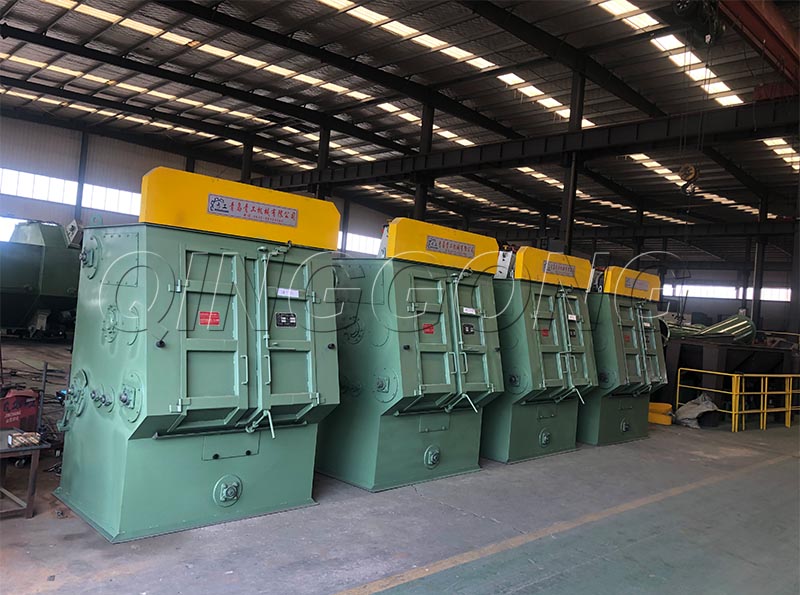
    First, we want to introduce you to the working principle of shot blaster machine. The blast wheel equips a high-speed rotating impeller that has 8 blades to project shot steel in a certain direction under the action of centrifugal force, and the remaining control cage and distributor form a complete blast wheel. There is a guard plate, it usually made by high chrome wear-resisting casting iron(a kind of strong and wear-resisting metal). There is an abrasive valve outside each blast wheel lined with the abrasive silo. Shot steel flows into the blast wheel through the valve, and the distributor rotates synchronously with the blades, making the shot steel get the initial velocity. Shot steel flies out through the window of the control cage and is thrown onto the high-speed rotating blade outside the control cage. After being accelerated by blades, it is projected to the surface of the workpiece that needs to be cleaned. Because the distributor and the blades rotate synchronously, Vibration-free transmission of the steel grit to the blade is ensured, thereby reducing the wear on the blade.

    advantages-of-shot-blasting-machine.jpg

    Advantages of Shot Blasting


    Then let's talk about the advantages of shot blasting. The workpiece will generate dust and other contaminants during the process of being cleaned. The working environment of the blast wheel is a closed type, therefore outside of the blast wheel will not be dusty when it's working. Normally,  there is no manual operation is required for the blast wheel, which saves labor costs and reduces a lot of risks. And its cleaning speed is relatively fast that can clean up a large number of workpieces shortly. Its working efficiency is very impressive, and the quality is reassuring. According to the purpose of the steel and the specified rust removal level, the ideal cleaning effect can be achieved.


    What is Grit Blasting?


    To comply with international emission standards, most of QINGGONG machinery's sandblasting tanks are used in conjunction with sandblasting rooms. One advantage is that reduces pollution emissions, and the second advantage is that abrasives can be recycled and used again. The sandblasting pot gains power by compressed air, a machine that forms a high-speed jet beam to inject the abrasive at high speed onto the surface of the workpiece which has to be processed. That is how the mechanical properties of the workpiece's outer surface are optimized.


    Advantages of Grit Blasting


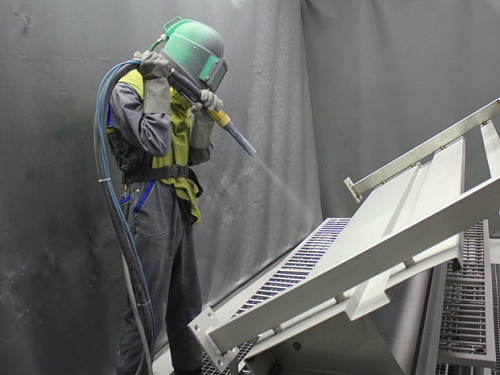
    Grit blasting is a surface strengthening process widely used in factories. The equipment for Grit blasting is very simple. The sandblasting gun of sand blasting gun manufacturers like QINGGONG uses a wireless remote control method, which can protect the safety of workers and is very convenient to operate. At the same time, Grit blasting is not limited by the shape and position of the workpiece, it is easy to operate, and it is very flexible in application. It can face a variety of situations. Grit blasting is widely used to improve the mechanical strength, wear resistance, fatigue resistance, and corrosion resistance of parts. It can also be used for surface matting, descaling, and eliminating residual stress of castings, forgings, weldments, etc.


    Shot Blasting VS Grit Blasting


    Shot blasting is usually in the form of the whole equipment, equipped with a shot blasting chamber and a dust removal system, and shot blasting can be said to be a tool in a sense, which can work in an open environment, or it can be used in a sandblasting room.


    Shot blasting's purpose is to fix the blast wheel in the blasting chamber. You can only change the angle of steel shot throwing by adjusting the control cage, while grit blasting can be operated by humans and the sandblasting gun can make arbitrary actions. Shot blasting is suitable for regular and continuous situations. And Grit blasting can be used in some blind spots, where it is more difficult to clean up. It is a supplement to shot blasting.


    Although the jet power and method of the two processes are different, they are all for high-speed impact on the workpiece, and the effect is the same. In comparison, Grit blasting is more accurate and easy to control accuracy, but the efficiency is not as high as shot blasting, and it is suitable for complex shapes. Small workpieces or workpieces that are difficult to clean.


    Shot blasting is more economical and practical, it is easy to control efficiency and cost, while the cost of Grit blasting is relatively low.

    Applications: When to Choose Shot Blasting or Grit Blasting?


    Choosing between shot blasting and grit blasting depends on the required surface finish, material condition, coating requirements, and production environment. Although both methods belong to abrasive blasting technology, they serve different industrial purposes.


    Applications of Shot Blasting


    Shot blasting is mainly used when manufacturers need efficient cleaning, consistent surface treatment, and improved metal surface quality. Because steel shots create a controlled impact instead of aggressive cutting, it is suitable for high-volume industrial production.

    • Automotive components: Cleaning engine parts, gears, wheels, and cast metal components before further processing.

    • Foundry industry: Removing sand, scale, and excess materials from castings after molding.

    • Steel fabrication: Preparing steel structures and fabricated parts before painting or coating.

    • Machinery manufacturing: Improving surface consistency and removing manufacturing residues.


    Applications of Grit Blasting


    Grit blasting is preferred when a stronger surface profile is required. The angular abrasive particles create a rougher texture that improves mechanical bonding between the surface and protective coatings.

    • Marine industry: Preparing ship surfaces and offshore structures for anti-corrosion coatings.

    • Heavy equipment: Removing thick rust, old paint, and surface contamination from large machinery.

    • Pipeline and construction: Creating suitable surface conditions before protective coating application.

    • Industrial maintenance: Restoring heavily corroded or damaged metal surfaces.


    How to Choose Between Shot Blasting and Grit Blasting?


    Selecting the right blasting method requires considering the final surface requirement rather than simply choosing the stronger process. The correct method can improve coating performance, production efficiency, and overall processing cost.


    Your RequirementRecommended MethodReason
    Need smooth and uniform surface cleaningShot BlastingSteel shots provide consistent impact and produce a cleaner surface finish.
    Need stronger coating adhesionGrit BlastingAngular grit creates a deeper surface profile for better coating bonding.
    Need continuous production processingShot BlastingAutomated shot blasting machines are suitable for large-volume manufacturing.
    Need to remove heavy corrosion or old coatingsGrit BlastingThe cutting action of grit particles removes difficult surface defects more effectively.
    Need metal surface strengtheningShot BlastingControlled impact can improve fatigue resistance of certain metal components.


    Frequently Asked Questions About Shot Blasting and Grit Blasting


    What is the difference between shot blasting and sandblasting?

    The main difference between shot blasting and sandblasting is the abrasive media and blasting method. Shot blasting typically uses metallic shots, such as steel shot, which create a controlled impact effect for cleaning and finishing metal surfaces. Sandblasting traditionally uses sand or other fine abrasives that cut and remove surface materials.

    Today, many industries avoid silica sand because of health concerns and use alternative abrasives such as steel grit, glass beads, or other engineered media instead.


    What is the difference between shot peening and shot blasting?

    The main difference between shot peening and shot blasting is the purpose of the process. Shot blasting is mainly used for cleaning, surface preparation, and removing contaminants from metal surfaces.

    Shot peening is a strengthening process that intentionally creates compressive stress on the surface of metal parts to improve fatigue resistance and durability. It is commonly used for critical components in aerospace, automotive, and engineering applications.


    Is grit blasting more aggressive than shot blasting?

    Yes. Grit blasting is generally more aggressive because angular abrasive particles cut into the surface and create a deeper profile. Shot blasting uses round media that produces a more controlled impact and smoother finish.


    Can shot blasting replace grit blasting?

    Shot blasting can replace grit blasting in applications where cleaning and surface uniformity are the main goals. However, when a specific surface roughness is required for heavy-duty coatings, grit blasting may still be the preferred solution.


    Which blasting method is better for painting preparation?

    Both methods can prepare surfaces before painting, but grit blasting is often selected when stronger coating adhesion is needed because it creates a rougher surface profile. Shot blasting is suitable when a cleaner and more uniform surface is required.


    Improve Your Surface Treatment Process with QINGGONG


    Selecting the correct abrasive blasting method can significantly improve surface quality, coating performance, and production efficiency. QINGGONG provides professional blasting solutions and equipment designed for industrial surface preparation applications.


    Contact our team to discuss your project requirements and find the most suitable blasting solution for your materials, production needs, and surface finishing goals.

    Get in touch with QINGGONG today for a customized abrasive blasting solution.

    References

    Tel:

    +8613235322903

    Add:

    No 377, Langyatai S Rd, Huangdao District, 266400, Qingdao City, China
